
Storytelling Training
Lesson 1: Why we all need to develop our storytelling skills

To communicate effectively, we need those we are trying to communicate with to listen with an open mind, without distraction (whether from external distractions or from within their own head), and we need them to remember what we are trying to communicate. This can be a daunting task; especially considering how much information bombards us minute to minute. We have little control over these external forces, but we do have control over our message and the way we present that message. It is the only control we have. So, how can we apply control? Through storytelling.
Our brain is wired for story. It is an evolutionary development that helped our ancestors progress and stay alive. To avoid learning everything the hard way, and possibly living a very short life, we learn vicariously through others’ experiences. We learn through stories. We might be learning what the outcome is of running into a sheep versus a saber tooth tiger as told to us around a tribal campfire; or maybe a more relevant example is through a cautionary tale shared on Facebook about what happens when we don’t have a pool fence.
We learn most effectively and memorably using story. It’s impact on our values, culture, and attitudes is monumental. From the stories we learned from our parents, at church, or through the movies and books we love most, these stories help us become who we are today. We emulate the heroes, and we condemn the villains (and decide which ones are the heroes and which ones are the villains). We decide which values are important to us through these examples, whether real or fictional.
Throughout history, stories have had tremendous impact on our culture. Consider the power of Uncle Tom’s Cabin in changing American attitudes about slavery? Just a fictional version of the life of a southern slave and a southern slave owner, but Harriet Beecher Stowe told a story in such a way as to affect attitudes about something people may not have personally experienced (mostly northerners). In fact, it is said that when Abraham Lincoln met her for the first time he said, “So, you’re the little woman who wrote the book that made this great war!”
So whether it is parables from scripture, stories shared by parents or grandparents, or Yoda in all his wisdom, story has a powerful influence in our lives. Neuroscience has proven that when we listen to a story, areas of our brains will actually synchronize with that of the teller (and mirror neurons are triggered, which helps us experience deeper understanding as we share their experience). A good story activates myriad areas of the brain so that we not only hear the words, we feel the emotion, see the action, sense and sometimes actually experience colors, smells, and sounds. Our brain is VERY good at focusing when it comes to story, so by engaging through storytelling we are utilizing a powerful tool.
Yes, stories have power and influence (for good or bad), but of course, we’ll only use our power for good here at School Webmasters—and help our clients to do likewise.
Stories can:
- Change minds
- Prompt action
- Provide an example
- Inspire others
- Make a connection
- Generate interest
- Build trust
- Explain who you are
Stories can influence where facts and data cannot. It is in our nature to be suspect of new things. That is because our species survived and thrived by avoiding those circumstances that pose a threat to us, and the unknown is a potential threat. It is a survival strategy that served our humans well. Now, in modern society those threats are more likely to be new ideas, processes, products, services, or other challenges to our known status quo. Our default is to be suspicious. Stories allow us to bypass our innate bias and form new opinions and make judgments by lettings us view things from the inside perspective of the story.
We will all benefit by developing our storytelling skills because we all want and need to communicate better. Whether you are a spouse, a parent, a friend, a teacher, or you are serving a client or coworker, your ability to communicate clearly and interestingly is vital. We hope these lessons on storytelling will help us all communicate more effectively.
You might also enjoy this TedTalk about the power of storytelling by Jonathan Gottschall, the author of “The Storytelling Animal.“
Lesson 2: What is a story? (elements)
As we discussed previously, story is part of our collective psyche. Every culture, throughout the ages, has shared stories. Even when we sleep we don’t dream in facts or opinions but in stories.
A few other benefits of storytelling are:
- They are memorable. One simple indication of how effective a story can be is to look at how the world’s best memory champions manage long lists. They put these words into a narrative and associate it with visuals in their minds. Yes, they are telling a sort of story to keep the information memorable. Another example is to simply think about the last lengthy presentation you sat through. What do you remember about it now? I’m pretty sure if the presenter told a story or two, that is what you will recall. Watch a Ted Talk and you’ll see that the most popular talks are the ones using story (and the very best ones are often one entire story).
- They convey emotion. In our modern age, especially in the fields of business and education, we are taught the importance of fact-based, rational, emotionless decision making. But scientific facts prove otherwise. In cases where the portion of the brain that registers emotions (prefrontal cortex) is damaged, the individual is no longer able to make rational decisions. Emotions are essential to wisdom and not a detriment (contrary to what some business management methodologies might suggest). Engaging emotion is essential if you hope to influence, engender trust, or inspire action.
- They create meaning. When something is completely incomprehensible to you, have you ever said, “Can you give me an example?” The result will usually be a story. It is then that the light comes on and you can understand or at least have more clarity. That is because we are hardwired to seek stories that provide us with concrete meaning. Neuroscience even tells us that when there is not a story to explain what is happening, we often just make one up that explains it. We are continually looking for rationale, and we use story to explain what we don’t understand. Check out this interesting silent animation video from 1944 that is likely to prove the point. Do you see a story?
The author of “Wired for Story, says,“You can’t change how someone thinks about something without first changing how they feel about it.” Story provides us with context for the facts that bombard us so we can make sense of them. You might enjoy watching Lisa Cron’s Ted Talk on how we are wired for story.
The idea of using storytelling in a business setting has become very trendy. However, most blogs and other articles conclude that “telling your story” is the process of describing your business, your product, or your service. They are making assertions or giving opinions. That is NOT a story. That is called marketing. What we want to focus on here is what a story actually is. So, let’s talk about the elements of a story as we will begin to use them in our corporate storytelling and for our clients in their website content development.
Lesson 3: How to recognize a story (in the moment)
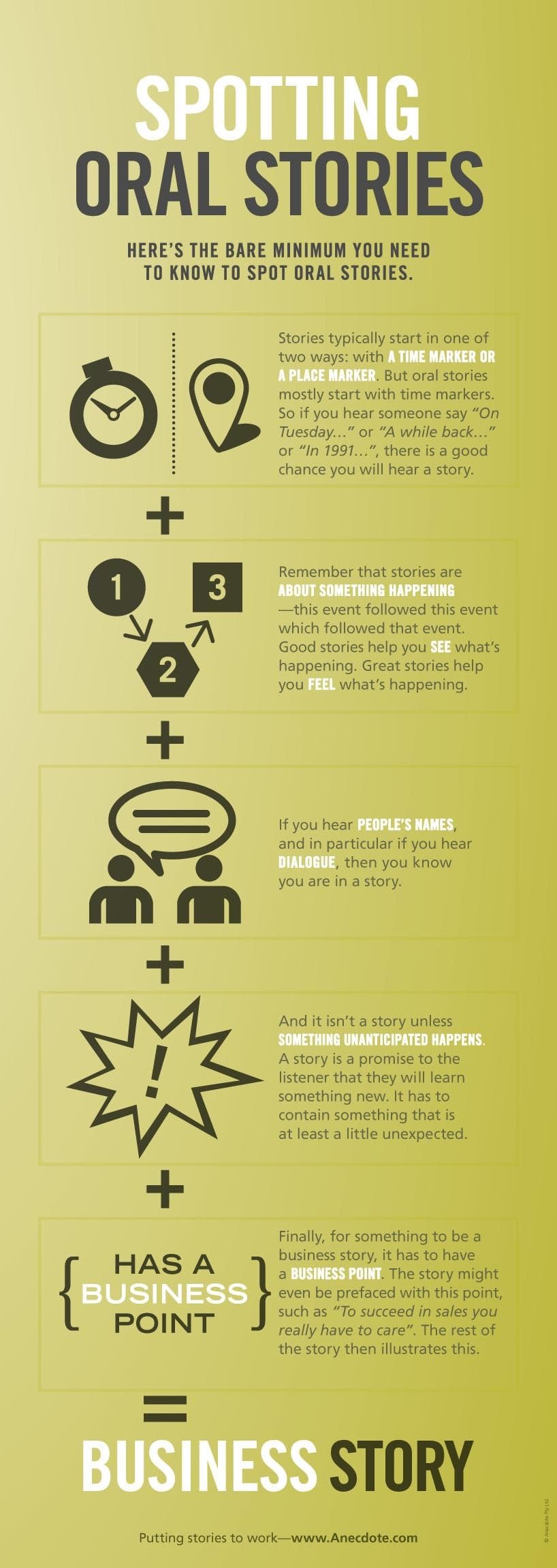
For the purposes of developing a business story (or in our case a school story), we’re recommending the methodology from Putting Stories to Work by Shawn Callahan. His excellent book recommends that you begin by learning to recognize the elements of a story. While this isn’t a rigid structure, it is an excellent guide to help you recognize a useful story.
- Time or place marker. This simply means that typical stories will begin with a time marker that sets your story in a time or place. Examples are ‘Just the other day…’ or ‘In 2014…’ or ‘We were in the teacher’s lounge…’ or ‘Mary was on the playground when….”
- Connected Events. A story describes something that happened. You will use (or hear) words like ‘and then…’ and ‘but…’ and ‘and after that….’ Those are usually indicators that you are hearing or telling a story. Connected events are the most basic elements of a story.
- People and their dialogue. Stories are about people doing things, and this includes dialogue. A sure give-away you are hearing a story is when you hear someone’s name followed by what they did or dialogue.
- Unanticipated information. You can also expect to hear something surprising, unknown, or an insight for the story to be effective and memorable. It doesn’t have to be amazing, just a bit unexpected.
- What’s the point? Finally, the best “business” or “school” story will have a business point. Luckily, almost any story can be turned into a business story just by knowing why you might tell it in a business (or school) context. Ask yourself, “What is the point of this story?”
When you begin to practice spotting stories, it will really open your eyes to what makes for a memorable presentation, talk, or conversation. It may also make you acutely aware of why a talk or presentation failed to make an impression (no stories). But, the first step in this process is being able to spot a story. It is not a passive exercise either. The stories you find and retell will have a huge impact on you personally and can change who you become. Stories shape who we are.
Lesson 4: How to gather and trigger stories
Our people are what makes School Webmasters stand out from the crowd of school website developers (and there are thousands, literally). We have some great stories about how our staff has helped our customers and have gone the extra-mile. It’s those stories, in particular, that we want to gather. Not only are they great to share with prospective customers, to show them who we are, but it also helps our new hires know what our goals are and what standards they should strive for. Our mission of “Delighting Our Clients” is more than just a slogan. It is actually the way we do business. Our people make us great.
Where do you look for stories?
All of these sources will provide you with many opportunities to have an experience (your story) or hear a story (other people’s stories). They might be a lesson you learned, a value you witness, an example of great leadership or customer service, or many other possibilities.
- Begin with your own. Ask yourself at the end of the day what has happened in the last 24 hours that might give you insight into your own character or that relates to company values. Jot down what you discover. (This is also a great way to start journaling if you don’t already.) There are so many things happening around you each day. Get in the habit of noticing them and making a few notes.
- Get out and about. Many of us are parents and grandparents, and that usually involves running errands and attending a variety of events. These are also great places to hear stories. Excursions of any kind can produce an abundance of story fodder.
- Other people’s stories. If we worked in the same office, I’d say pay attention in the lunchroom or around the watercooler. A good listening ear (story listening) and asking the right questions will provide you with many interesting stories. Just always acknowledge that a story you heard isn’t yours with a disclaimer of something like, “Just the other day, Mary told me about….”
- Social media. There are also the many social media forums where our friends and family share their stories. Just be sure you don’t use unproven sources with already packaged stories that go viral since many of those aren’t true. This could be shared with something like, “A few weeks ago, I saw a story on Facebook that really reflects my feelings about..,” and then share the story.
Coaxing stories from others
In our company, one of the most useful storytelling efforts is to gather stories from our clients. This is often quite difficult to do, and you will need to learn to encourage them to share. But here are a few tips to help you out:
- Asking the right questions in the right way. Have you ever asked one of your children, “How was school today?” or “What did you do in school today?” Most of the time, the response you get will be “Fine,” or “Nothing.” Try asking questions that begin with “When” or “Where” instead. This is because stories are usually tied to a time or place. When or where will take them to a moment in time, and you’re more likely to get a story rather than an opinion (or nothing in the case of your kids). The exception to this is when you can ask, “What happened? That one will likely elicit a story.
- A story of your own. Another aid will be to share a story of your own. You may find that as soon as you share one of yours, the client or coworker will share one of theirs. Try it on your children, and you’ll see what I mean. For example, “I had such a busy day today, but it felt good since I got so much done, like the….” then see if your story begets a story from them without your needing to ask. Often it does. With a client, use a story similar in nature to the topic you are seeking a response to.
- Published stories and movies. Next time you read a book, especially a business or self-help book, notice the stories as examples the author uses. As the effectiveness of stories has become accepted, they are easy to find. Especially abundant are stories that exemplify a company’s values or an innovator’s drive. Movies are also great resources because they allow you to pick a scene (which is a mini story) and use it as your analogy to the message you want to make. Your movie reference will need to be appropriate for your audience, of course.
The goal is to find stories that engage, influence, and inspire. These can be used within the company to train and encourage one another; they can be used for prospects and clients (to engage, influence, and convince); and they can be used in conversation with others about what we do in our jobs and why it matters.
Lesson 5: Recording and sharing your stories

As a company, and I highly recommend you do this for your own personal growth as well, we want you to gather stories. We also want you to archive them for future access to be used as part of our corporate storytelling database. We’ve created a corporate story database where you can jot down the basics, just enough to remind you about your story.
You will begin by adding your own tab (by just right clicking on another tab and then clicking on the “duplicate” link and renaming it as your own). Use this to store the stories that influence you in some way, represent our values, or that are just funs. There is also a column for the full story. We recommend that you just type out the story (somewhere on Google drive) and then link to it from this field. That way, if someone would like to understand the story (and use it in their own work), they will have it as well.
Getting started
The first step in story gathering and recording is to be aware of stories you hear or experience. You can do this by keeping your own story journal (or Evernote, Onenote, Word, or whatever format works best for you), or you can just use the corporate story database. I’m sure you are thinking that you don’t have any stories of your own, but let me assure you that you do. We all do. The problem is that we don’t recognize them, and even when we do, we don’t record them. Try this. At the end of every day, ask yourself these questions:
- What stood out for me today?
- Did I hear any good stories?
- Did I read any good stories?
For each story that these questions generate, answer this question:
- What’s the point this story makes?
If the story makes a business point or represents one of our company values, be sure it makes its way to the corporate story database. If it is more of a personal value, an example you can share with your children or spouse, or just a great story you want to share in conversation, be sure it makes its way to your story journal. The very act of recording your story will make it memorable, and you’ll be able to use it the next time you want to make a point that is backed up with an actual story and not just facts. This is especially useful for children when it seems they only hear lecturing when you try to teach them something. Wrap that lesson up with an actual story, and you’ll be amazed at the difference in their receptivity to your message.
The whole process probably won’t take you more than five minutes a day to record. It would take longer to write out your whole story and add it to the corporate story database, but please help us out by doing it when your story applies. So, what applies as good story gathering ideas for School Webmasters to use in its marketing efforts?
Story Examples for School Webmasters
- Employee skillsets. We love to share stories that show how our employee skills provide expertise to our clients at a cost far less than they could hire someone in house and that gives them a far better outcome. (What do we do that they don’t know how to do, like ADA compliance, copywriting, storytelling, royalty free images, best practices, etc.)
- Customer service. Sharing a story about how our staff goes above and beyond to provide great customer service shows prospects that they can get the help they need and enjoy the process because we are there for them.
- Time savings. School staff are wearing many hats, and when we can share stories about how we can get the website updates done quickly, with very little effort on their part, and make them look good in the process, these are win-win stories.
- No training needed. One thing that using our services provides our clients is that they no longer have to train and retrain their staff (or check their work). When we have stories that show how involved proper website management (or social media, communications, or PR) actually is, and that we do it for them, they feel confident that they will get more from us than if they used another vendor.
- Having control. Some of our prospects worry that by trusting us with their website management, they will be giving up control. Stories that show them that we let them maintain the control, but we make sure their wishes are fulfilled, they will be reassured that they are giving up nothing but are gaining a lot.
- Continuity and consistency. We love stories that show prospects that by maintaining consistency (using our staff who are all trained with the same high standards) gives them a much better outcome. Also, because they are using our staff, they will always get continuous quality, regardless of their own staff turnover.
- Better than a CMS. We are always looking for stories where a client has shared that working with us is so much better than managing their own CMS system (and ways that it has helped, with specifics). Maybe it is the project coordinators who are most likely to hear these stories, but we need to know the specifcs and the “why” working with us helps them (time, quality, money, branding, communications, etc.).
- Quality control. Stories showing evidence of us catching their mistakes and fixing them (broken links, wrong dates, outdated information, etc.).
If you use a story journal (in whatever format you prefer) each weekday for a month, you will be amazed at the types and quality of stories you will have gathered. You will not only be sharing with the company, but you will find that stories will have an impact on the quality of the communications you have with your family and friends as well. Heck, you’ll just be a more interesting person all the way around. So give it a try. Please let Bonnie know when you’ve added what you believe is an effective story to the database so she can go check it out and see if we can use it as part of our storytelling culture!
How to record your stories
Let’s look an example of how you might record a story that you heard or read or experienced (so you’ll be able to remember it later to retell it). A sample format might look like this:
Topic:
Title (That one where…):
Date/Place stamp:
Events:
People:
Surprise?:
Business point:
Where to use:
Tags:
Story source:
Full story link:
In addition to the details for each category listed in Lesson 3, here are a few categories not covered in that lesson:
Topics
Categorizing your story by topic can help you recognize where to use it and how. This could be anything that fits your needs. Some examples are “personal values” or “benefits” or “founder story” or just about anything that helps you recall the story later.
Titles
This is just a description that means something to you. In the TV series Friends, the episodes were titled with descriptions like: “The one where where Rachel finds out,” or “The one where Phoebe runs.” These titles are helpful in triggering the memory for you, and often that is all it takes to bring the whole story to mind. Use whatever title will trigger the story for you.
Tagging Stories
Another important aspect of story gathering is to be able to use a story to make a point (which can make a huge impact on your effectiveness and influence). You can begin by making a list of the things you care about (what’s really important to you). This also applies to the company’s needs for storytelling to influence customers and prospects about what we have to offer and why they should care. As an example, some key topics/tags that might be useful to us would be:
- Attention to detail
- Quality
- Customer service
- Problem solving
- Creativity
- Innovative
- Expertise
- Proactivity
- Honesty
- Seek understanding
- Consistency
- Saving time
- Saving money
- Have your back
- Loyalty
- Communication
You can then use your story database, or whatever program you are using, to tag your stories with the single words or phrases you associate with stories so you can find the right one when you need it. So, if you are talking to a client and want to emphasize the quality of “attention to detail” during your client meeting, you could search on the tags of “attention to detail” or “quality” and find a relevant story. It is likely that just seeing the title of your story will be enough to bring the whole story to memory. Your story can add credibility to your message.